
Energy audits and energy consulting for companies.
We check how much energy businesses and non-residential buildings use and show which measure pays off first. For companies in Heidelberg, Mannheim and the Rhine-Neckar region.
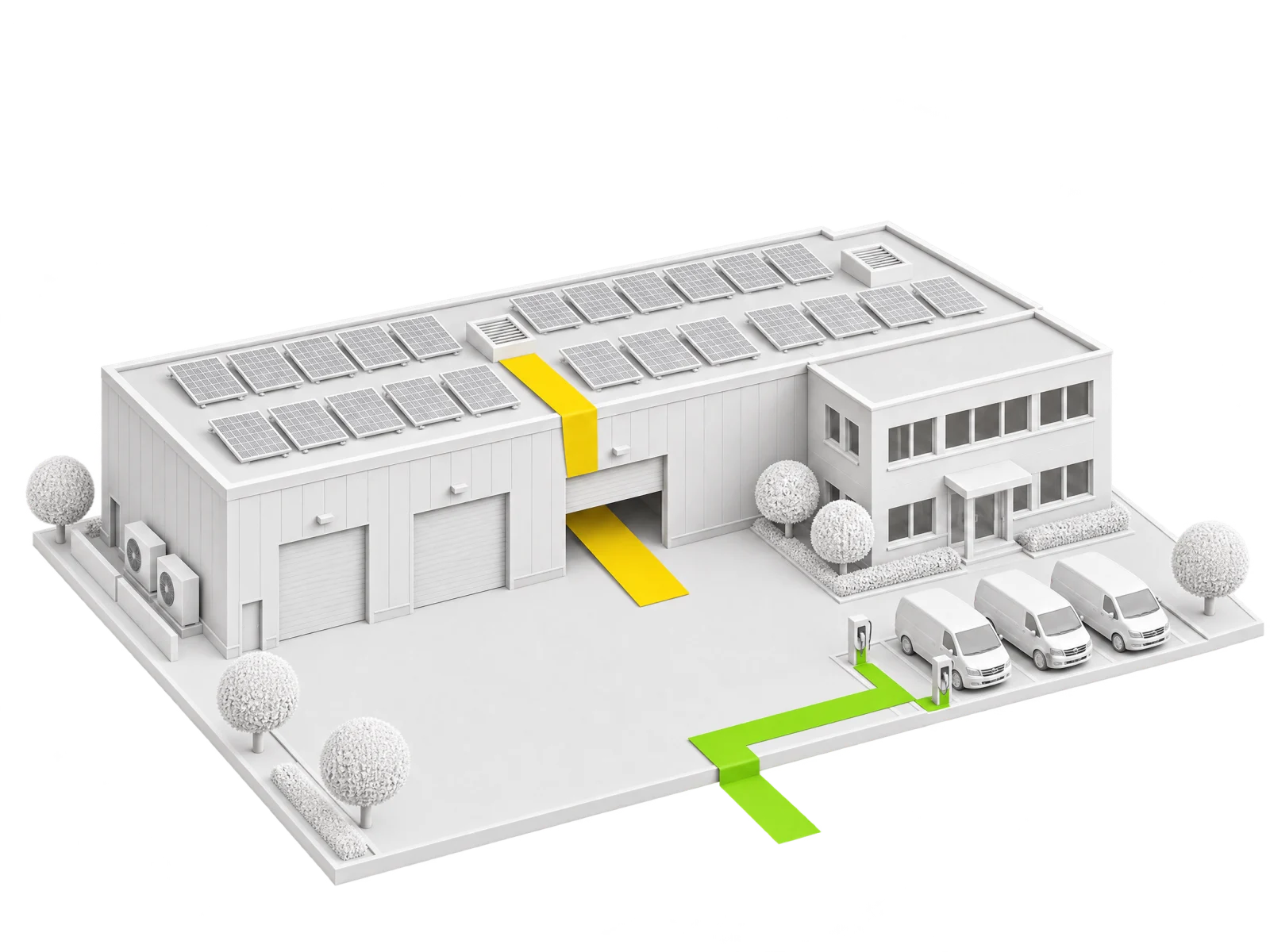
Who must carry out an energy audit?
Today: every company that is not a small or medium-sized enterprise must carry out an energy audit to DIN EN 16247-1 and repeat it at least every four years. Companies that have set up, or begun to set up, an energy management system to DIN EN ISO 50001 or an environmental management system under EMAS are exempt.
A government bill (Bundestag printed paper 21/8027) would redefine the duty: what would count is no longer company size but an average energy use of more than 2.77 gigawatt hours a year over the last three calendar years. The Bundestag referred the bill to committee on 24 September 2026. It has not been passed.
As of 17 November 2026
What you get.
Energy audit to DIN EN 16247-1
We record consumption, equipment, buildings and processes and document the audit the way the standard requires.
Non-residential buildings to DIN V 18599
We assess the building envelope, heating, ventilation, cooling and lighting with the standard's calculation method.
Action plan with cost, savings and payback
Every recommendation with investment, annual savings and payback period, ranked by impact.
Guidance on funding programmes
We show which funding programmes may apply to your measures and what they require.
How an energy audit runs.
First call
We agree which sites, buildings and equipment the audit covers and which data already exist.
Data and site visit
We collect consumption data and look at buildings, equipment and processes on site.
Analysis
We evaluate consumption, find the largest users and calculate measures.
Report and action plan
You receive the audit report and an action plan to decide on.
Funding.
Energy consulting for non-residential buildings, equipment and systems (BAFA)
Until 31 December 2026, BAFA funds energy audits to DIN EN 16247 with 50 % of the consulting fee, up to 3,000 euros, or up to 600 euros where annual energy costs are 10,000 euros net or less. Until then, energy consulting for non-residential buildings to DIN V 18599 is also eligible. The consulting must be done by a person on the Energieeffizienz-Expertenliste.
Federal funding for efficient buildings (BEG)
For renovating non-residential buildings there is the federal funding for efficient buildings (BEG).
Transformation plans (BAFA, module 5)
Funding covers plans with which a company maps its path to greenhouse gas neutrality. Applications go to the project agency VDI/VDE Innovation + Technik.
As of 17 November 2026
Where we work.
We are based in Schriesheim. We advise companies in the region and across Germany.
- Schriesheim
- Heidelberg
- Mannheim
- Weinheim
- Ladenburg
- Rhine-Neckar
Common questions.
Does our company have to carry out an energy audit?
Under current law, yes, if your company is not a small or medium-sized enterprise as defined in European Commission Recommendation 2003/361/EC and has not set up an energy or environmental management system.
How often is an energy audit due?
At least every four years, counted from the completion of the last energy audit.
Energy audit or energy management system?
An energy audit is a stocktake that is repeated every four years. An energy management system to DIN EN ISO 50001 is an ongoing process. Companies that set one up are exempt from the audit duty.
What drives the cost of an energy audit?
Mainly the number of sites and buildings, the amount of equipment and how complete the consumption data already are. In a first call we work out where to start and what it costs.
Is there funding for smaller companies?
Until 31 December 2026, BAFA funds energy audits and energy consulting for non-residential buildings with 50 % of the consulting fee.
How does DIN EN 16247 differ from DIN V 18599?
DIN EN 16247-1 governs energy audits: they look at a company's entire energy use, including buildings, equipment, processes and transport. DIN V 18599 is the calculation method for the energy balance of buildings. We use it to assess non-residential buildings and plan their renovation.
Have your energy use checked.
In a first call we work out whether an audit is required, where to start and what it costs.